


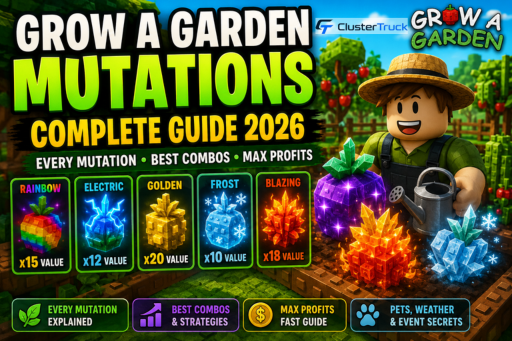
If you’re searching for the ultimate Grow a Garden mutations guide, you’re probably looking for one answer: how to make your crops worth significantly more money. Mutations are the heart of the game’s progression because they transform ordinary harvests into extremely valuable produce capable of generating massive profits. Whether you’re a brand-new farmer planting your first seeds or an experienced player optimizing every harvest cycle, understanding mutations is the fastest way to increase earnings without endlessly expanding your farm.
Unlike standard crop growth, mutations rely on special conditions, environmental effects, weather events, pets, and game mechanics that influence each harvest differently. Some mutations are relatively common, while others are incredibly rare and can multiply a crop’s value several times over. Learning which mutations stack together, how to trigger them consistently, and which crops benefit the most gives players a major advantage over those relying purely on luck. This guide explains everything you need to know about Grow a Garden mutations, including how they work, which ones are most valuable, beginner-friendly strategies, advanced optimization techniques, performance tips, and answers to the questions players search for most frequently.
What Are Grow a Garden Mutations?
Grow a Garden mutations are special modifications applied to crops when specific conditions are met during the growing process. Instead of harvesting a normal fruit or vegetable, players receive an enhanced version that carries unique visual effects and a much higher selling price.
Mutations are designed as one of the game’s primary progression systems. Rather than simply unlocking bigger farms, players improve efficiency by producing increasingly valuable harvests through careful planning. Different weather events, crop placement, seasonal updates, pets, equipment, and random environmental mechanics all influence whether a mutation appears.
The developer continues expanding the mutation system through regular content updates, introducing fresh mechanics that keep farming strategies evolving. As a result, experienced players constantly experiment with new combinations to discover the highest-value harvests.
How Grow a Garden Mutations Work
Every planted crop has the potential to receive one or more mutations before harvest. The game checks several variables throughout the growth cycle instead of only at the moment a crop finishes growing.
Important factors include crop rarity, active weather effects, nearby objects, special events, equipped pets, fertilizers, growth boosts, and temporary seasonal bonuses. Some mutations can occur independently, while others require another mutation to exist first before becoming available.
This layered system creates a rewarding gameplay loop where players gradually improve their farms by understanding mechanics instead of relying entirely on random chance. While luck still plays a role, efficient farm layouts and proper preparation dramatically improve long-term results.
Why Mutations Are So Valuable

Why Mutations Are So Valuable
Mutations directly increase crop value, making them the single biggest source of profit throughout the game.
Instead of harvesting dozens of ordinary plants, many advanced players focus on producing fewer crops with powerful mutation combinations. This strategy reduces wasted space while maximizing income during every harvest cycle.
Higher-value crops also accelerate progression by allowing players to purchase expensive seeds, unlock better equipment, expand farmland, acquire stronger pets, and prepare for future updates much faster than players ignoring mutation mechanics.
Because of this economic impact, nearly every experienced Grow a Garden player prioritizes mutation farming over simple crop production.
Common Types of Grow a Garden Mutations
Although updates regularly introduce additional effects, mutations generally fall into several recognizable categories.
Weather mutations occur during rainstorms, thunderstorms, snowfall, heatwaves, or other environmental events. These are among the easiest for beginners to understand because they naturally happen while crops are growing.
Elemental mutations apply visual changes inspired by fire, electricity, frost, nature, or magical effects. These often provide higher multipliers than basic weather mutations.
Seasonal mutations appear during limited-time events. Halloween, Winter, Spring, Anniversary, and Summer updates frequently introduce exclusive mutations that remain highly desirable.
Rare mutations are significantly harder to obtain and usually provide the largest selling bonuses. These often become the focus of endgame farming strategies.
Stacking mutations combine multiple effects on a single crop, creating exceptionally valuable harvests that experienced players actively pursue.
Best Crops for Mutation Farming
Not every crop performs equally well when mutations are involved.
Long-growth premium crops often deliver the greatest returns because each successful mutation affects an already valuable harvest. Although these plants require more patience, their profit ceiling is dramatically higher.
Mid-tier crops provide an excellent balance between growth speed and earning potential. Many players build consistent income by repeatedly harvesting these crops while waiting for rarer plants to mature.
Fast-growing beginner crops remain useful because they generate many mutation attempts within a short period. Even if individual harvests sell for less, repeated opportunities eventually produce profitable results.
The most successful farms usually maintain a balanced mixture of quick crops for consistency and premium crops for massive payouts.
Beginner Strategy for Farming Mutations
New players should avoid chasing the rarest mutations immediately.
Instead, focus on maintaining continuous crop production while learning how weather cycles influence harvest quality. Planting consistently gives more opportunities for mutation rolls than waiting for perfect conditions.
Invest early profits into expanding farmland before purchasing expensive cosmetic items. A larger farm naturally creates more mutation opportunities and produces steadier income.
Pay close attention to update announcements because limited-time events frequently increase mutation chances or introduce temporary bonuses that help newer players progress much faster.
Patience remains one of the strongest advantages in Grow a Garden. Building efficient routines almost always outperforms relying on lucky harvests.
Advanced Mutation Stacking Strategies
Experienced players rarely settle for a single mutation.
Instead, they design farms specifically to maximize stacking opportunities, allowing one crop to receive multiple enhancements before harvest. Successfully stacked crops often generate dramatically larger profits than ordinary mutated plants.
Advanced players carefully monitor weather timing, activate growth boosts, position supportive pets effectively, and synchronize planting schedules with seasonal events. Every decision increases the probability of producing premium harvests.
Many veterans also maintain separate farming zones dedicated to different crop types, making it easier to manage growth cycles without interrupting ongoing mutation attempts.
Although stacking requires planning and patience, mastering this system separates casual farmers from the wealthiest players.
Best Settings for Efficient Farming
While Grow a Garden isn’t graphically demanding, smoother gameplay improves farming efficiency.
Reducing unnecessary visual effects during crowded servers helps maintain stable performance, especially when many crops mature simultaneously. Consistent frame rates make harvesting and replanting significantly faster.
Players should also enable autosave features whenever available and maintain stable internet connections to minimize interruptions during major weather events or seasonal activities.
Organizing inventory regularly prevents valuable mutated crops from becoming difficult to locate, saving considerable time during long farming sessions.
Latest Updates and Community Strategies
Grow a Garden continues receiving frequent updates that reshape farming strategies through new crops, seasonal content, pets, balance adjustments, and additional mutation mechanics.
The community actively experiments after every patch, quickly identifying profitable combinations and sharing optimized farming methods. Players constantly compare mutation rates, stacking possibilities, and efficient layouts to maximize earnings.
Because balance changes occasionally adjust crop values or mutation probabilities, staying informed allows players to adapt before older farming strategies become outdated.
Successful farmers treat updates as opportunities rather than obstacles, continuously refining their techniques as new mechanics arrive.
Featured Snippet: What Are Grow a Garden Mutations?
Grow a Garden mutations are special crop upgrades triggered by weather, events, pets, or other gameplay mechanics. Mutated crops sell for significantly higher prices than normal harvests, and some rare mutations can stack together, creating extremely valuable produce that greatly accelerates progression and farm expansion.
Why Players Love the Mutation System
One reason Grow a Garden has developed such an active community is that mutations make every harvest exciting. Even after hundreds of farming sessions, players never know exactly which crops will transform into valuable variants.
The system rewards preparation without eliminating randomness. Beginners can enjoy occasional lucky harvests, while experienced players benefit from mastering deeper mechanics. This balance keeps progression satisfying over long periods and encourages experimentation instead of repetitive grinding.
Seasonal events, evolving strategies, and regular updates ensure mutation farming remains fresh, giving players new goals beyond simply planting larger fields.
FAQs
Q1. hat is the best mutation in Grow a Garden?
The best mutation depends on the current update, but rare stacked mutations generally provide the highest selling prices and the greatest long-term profit.
Q2. Can multiple mutations stack on one crop?
Yes. Certain mutations can combine, creating much more valuable harvests than crops with only a single mutation.
Q3. weather events increase mutation chances?
Weather often plays a major role in triggering specific mutations, making event timing an important part of advanced farming strategies.
Q4. crops are best for mutation farming?
Premium, high-value crops usually offer the largest profits, while fast-growing crops provide more mutation attempts over time.
Q5. Are mutations permanent?
Mutations only affect the harvested crop. New plants must grow again before receiving additional mutations.
Conclusion
Mastering Grow a Garden mutations is the fastest path toward building a thriving and highly profitable farm. By understanding how weather, seasonal events, crop selection, and mutation stacking interact, players can consistently harvest crops worth far more than ordinary produce. Whether you’re just starting your farming journey or optimizing an advanced garden, focusing on efficient mutation strategies will dramatically improve your progression, earnings, and overall gameplay experience throughout 2026 and beyond.
